Imagine you’re in the movie The Matrix but…
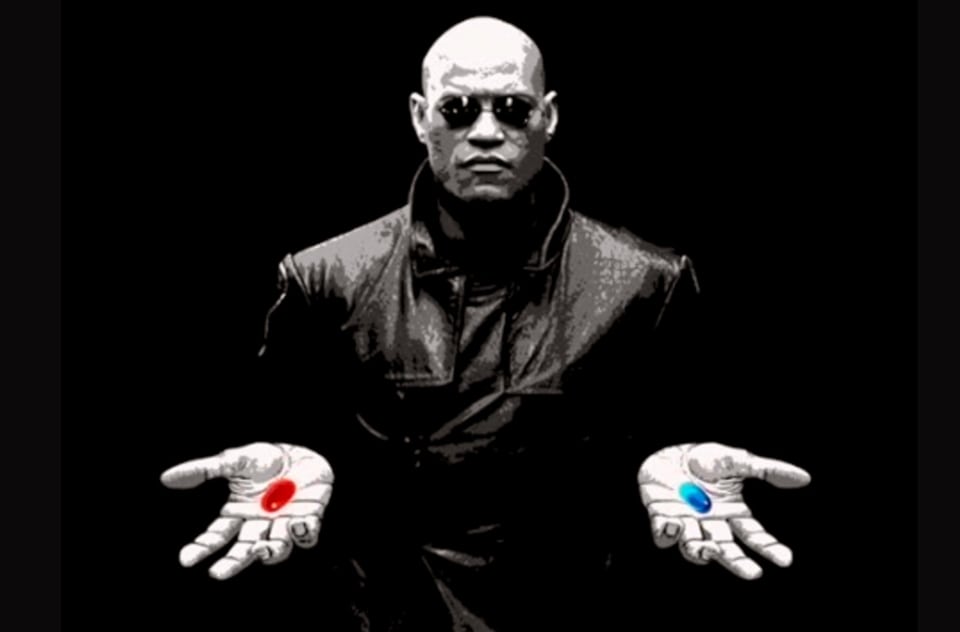
When Morpheus offers you the blue pill or the red pill, instead of this being a choice between learning about the Matrix or going back to the simulated world, instead it’s learning about the Theory of Constraints or going back to standard accounting principles. One option will open your mind to a new truth, the other will take you back to a “fake” world.
The famed business writer Peter Drucker said “What gets measured gets done”. This quote is apt because we all need to be aware that there is a huge, unchecked influence on our decision making process based on the metrics we choose to look at (or in some cases don’t choose but are given by other stakeholders). Choosing the metrics should be a carefully though-out process because there will be implications to whatever is used. Not only directly influencing business decisions, but possibly resulting in second and third order consequences we didn’t think of.
The problem in the world of accounting is we are handed a set of rules and standardised metrics that we are employed to uphold (GAAP). Made all the worse by the fact that we trudge through 20+ long examinations to learn this material in order to say that we are qualified. This hardly sets up an optimal situation for critical thinking. Instead we mostly blindly follow what we were taught after working so hard to be taught it in the first place.
By taking a deep dive into the world of TOC these past few months, reading as many books as I can get my hands on, from manufacturing through to retail; I’ve been having a blast learning that not all of these accounting assumptions could be true.
One example of this is measuring “efficiency”. Higher efficiency is good in standard management accounting logic, and low efficiency is bad. After all, it is intuitive that having people standing around unable to work is obviously bad. You don’t need to be fully qualified accountant to know that.
It turns out that by using TOC principles you can reason out that efficiency is not a good metric in a lot of business cases. Measuring efficiency leads to excess inventory, longer lead times, and ultimately lower profits. Efficiency is bad! This thinking is hardly unique to TOC either. These sorts of ideas are part of the Lean movement and JIT as well.
Thankfully the CIMA qualification covers all of these concepts, at least to some degree. And TOC is very much part of the P2 module “Managing Performance”. However CIMA also teaches all the stuff that TOC rails against. So it’s only by reading more in-depth outside of your accounting qualification materials, that you are able to pick up on these nuances and form the critical thinking needed to decide for yourself.
Interestingly, Eli Goldratt the inventor and guru behind TOC was originally working as a physicist and only got involved in business by chance when a neighbour of his was complaining about a problem at work. It’s telling I think, that someone with no business background and with a different set of logical frameworks from which to see the world was so effectively able to challenge the status quo and propose alternative ways of working.
 Jimmy's Corner of the Internet
Leave a comment